If you have started preparing for Amazon, you will have quickly realized that Amazon behavioral interview questions are very important. These are not trick questions. They are also not easy.
The interviewers want real-life examples from your work experience, and they will ask for details.
What makes it tough is that your responses are evaluated based on Amazon’s Leadership Principles. So it’s not just about what you did but also about how you think and make decisions at Amazon.
This article explains Amazon interviews simply. You will understand how behavioral interviews work at Amazon, along with a brief overview of the Leadership Principles.
You will also see examples of commonly asked Amazon behavioral interview questions and learn how to answer them naturally using the STAR method.
Key Takeaways
- Amazon behavioral interviews test Leadership Principles through real experiences.
- The STAR method keeps behavioral answers clear and structured.
- Strong answers highlight ownership, decisions, and measurable impact.
- Flexible real-world examples help tackle multiple Amazon questions.
- Mock interview practice improves confidence and delivery.
What Are Amazon Behavioral Interview Questions?
Amazon behavioral interview questions test you on how you handled real situations in the past. Instead of asking what you know in theory, Amazon wants to see how you actually work when there is pressure, ambiguity, conflict, or responsibility on the line.
The company looks closely at your past experiences and compares them with its Leadership Principles, which play a major role in hiring decisions.
These questions are different from technical interviews. Technical rounds focus on your coding, system design, analytics, or role-specific skills. Behavioral interviews focus on how you think, how you lead, how you make decisions, and how you respond when something does not go as planned.
If you are trying to understand the complete hiring flow, you can also review the Amazon interview process.
Why Does Amazon Use Behavioral Interviews?
Amazon uses behavioral interviews because the company believes past behavior is one of the best signs of future performance. Behavior-based hiring is often used for that reason, too. SHRM notes that this approach can increase the probability of successful hiring to 80–90%1.
The idea is simple. The way you handled real problems before says a lot about how you will handle them again.
These questions help Amazon evaluate a few things very closely: leadership, decision-making, ownership, and problem-solving. Interviewers want to know whether you can take initiative, stay accountable, and make smart calls without waiting for someone else to step in.
That is why so many Amazon questions begin with phrases like, ‘Tell me about a time’ or ‘Give me an example of’. The interviewer is not looking for a perfect answer. They are looking for a real one.
How Are Amazon Behavioral Interviews Structured?
Amazon’s interview process usually includes more than one stage. It often starts with a recruiter screen, followed by technical interviews for role-specific skills, and then behavioral interviews where your experience gets a closer look. For many candidates, there is also a Bar Raiser round.
The Bar Raiser is important because the interviewer helps keep hiring standards high across the company. Their job is not just to check whether you are qualified for the role, but to make sure the hiring bar stays strong across Amazon as a whole.
Amazon Leadership Principles Explained
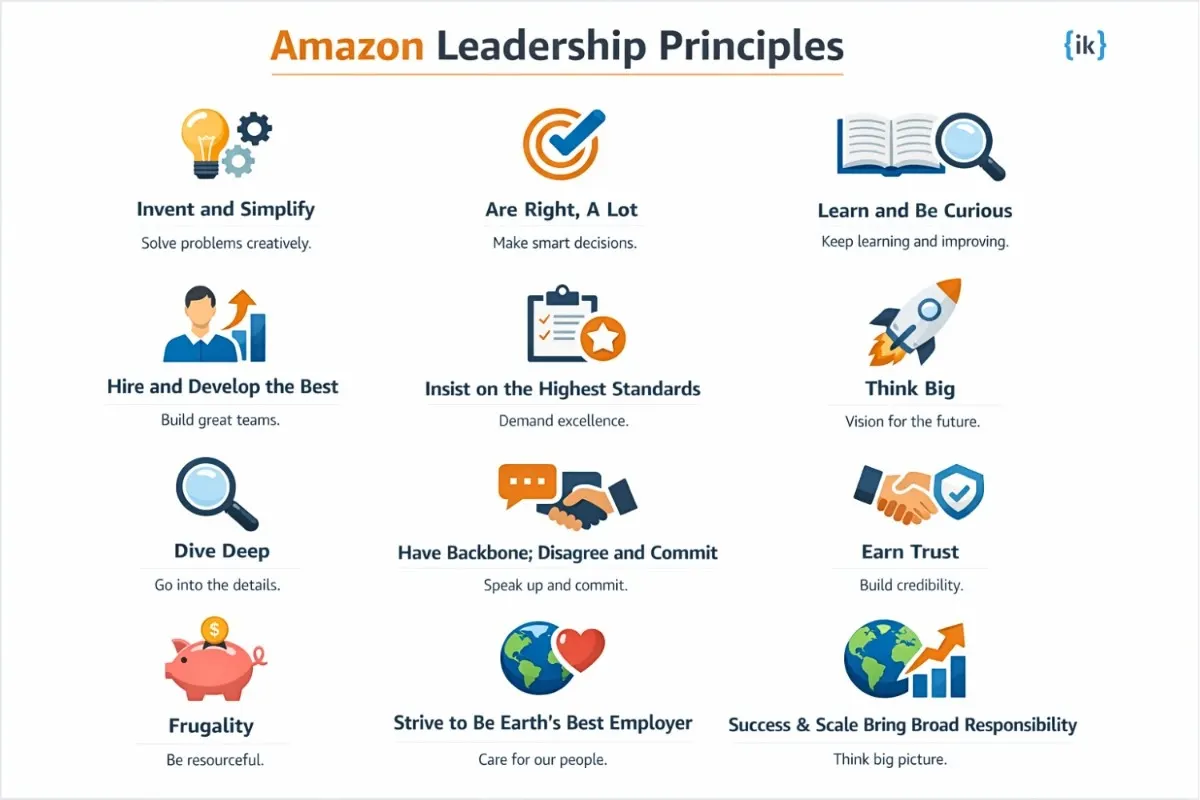
Amazon’s behavioral interviews are built around its 16 leadership principles, which Amazon says explain how it does business, how leaders lead, and how hiring decisions are made. In practice, that means most behavioral interview questions are really testing how closely your past work aligns with those principles.
Here is a quick snapshot of a few of the most commonly discussed ones:
| Leadership Principle |
Meaning |
| Customer Obsession |
Focus on customer needs and work backward from them. |
| Ownership |
Take responsibility beyond your immediate task or team. |
| Bias for Action |
Make thoughtful decisions quickly instead of getting stuck waiting. |
| Deliver Results |
Push through obstacles and focus on outcomes that matter. |
Amazon wants evidence that you can think clearly, act responsibly, and make good calls in real situations. That is why one interview question can often map neatly to more than one principle.
1. Customer Obsession
This principle is about starting with the customer and working backward. Amazon says leaders earn trust by focusing on customer needs first, even when competitors are in the picture. A common interview question under this principle is: Tell me about a time you solved a difficult customer problem.
2. Ownership
Ownership means treating a problem as your responsibility, even if it falls outside your direct job description. Amazon describes this as thinking long term and acting on behalf of the entire company, not just your own team. A typical question here is: Tell me about a time you took ownership of a project.
3. Bias for Action
Amazon uses this principle to look for people who can move quickly without being reckless. The focus is on making timely decisions, especially when the situation is changing or the cost of delay is high. A common question is: Tell me about a time you had to make a quick decision.
4. Deliver Results
This principle is about follow-through. Amazon wants people who can keep pushing until the work is done and the goal is reached, even when the path gets messy. A typical question is: Tell me about a time you achieved a challenging goal.
The rest of the principles follow the same logic, as outlined in the image below:
How to Answer Amazon Behavioral Interview Questions Using the STAR Method?
The easiest way to answer Amazon behavioral interview questions is to use the STAR method. It keeps your answer organized and helps you give enough detail without rambling.
STAR stands for Situation, Task, Action, and Result.
Instead of telling a vague story, you walk the interviewer through what happened, what you were responsible for, what you actually did, and what changed because of it. That structure works well in behavioral interviews because it gives a clear picture of how you handle real work.
If you are still building your overall interview plan, coding interview preparation is a good place to start.
1. Situation
Start with the background. Set the scene briefly so the interviewer understands what was going on. Keep it focused on the part of the story that matters.
2. Task
Next, explain your responsibility. What was expected of you, and what problem were you being asked to solve?
3. Action
Now come to the part that matters most: what you did. Be specific about your choices, your approach, and the steps you took. This is where your judgment and problem-solving show up.
4. Result
End with the outcome. Whenever possible, use numbers or a clear business impact. You can mention things like improved performance by 20%, reduced operational cost, or delivered the project ahead of deadline. A strong result makes the answer feel complete and credible.
Top Amazon Behavioral Interview Questions
Amazon behavioral interviews usually circle back to a few core themes: customer focus, ownership, speed, handling disagreement, and learning from mistakes. The questions below are grouped by theme so they are easier to practice and easier to map to Amazon’s Leadership Principles.
1. Customer Obsession Questions
- Tell me about a time you handled a difficult customer.
- Describe a time you improved the customer experience.
- Tell me about a time you went out of your way to help a customer.
- Describe a situation where you had to balance customer needs with business constraints.
- Tell me about a time you received negative customer feedback.
- Describe a time you turned an unhappy customer into a satisfied one.
- Tell me about a time you spotted a customer problem before others did.
2. Ownership Questions
- Tell me about a time you took ownership of a project.
- Describe a time you went beyond your responsibilities.
- Tell me about a time you stepped in when no one else was taking charge.
- Describe a project that you carried from start to finish.
- Tell me about a time you fixed a problem that was not originally yours.
- Describe a time you took responsibility for a mistake or missed a deadline.
- Tell me about a time you acted like the owner of a process or team outcome.
3. Bias for Action Questions
- Tell me about a time you made a quick decision.
- Describe a time you worked under pressure.
- Tell me about a time you had to act with limited information.
- Describe a situation where waiting would have caused problems.
- Tell me about a time you moved fast to solve an urgent issue.
- Describe a time you balanced speed and accuracy.
- Tell me about a time you had to make a call before you felt fully ready.
4. Conflict Resolution Questions
- Tell me about a time you disagreed with your manager.
- Describe a conflict with a coworker.
- Tell me about a time you had to handle a difficult conversation.
- Describe a situation where two team members did not agree.
- Tell me about a time you pushed back on an idea.
- Describe a time you handled a disagreement without damaging the relationship.
- Tell me about a time you had to get buy-in from someone skeptical.
5. Failure Questions<h3>
- Tell me about a time you failed.
- Describe a mistake you made at work.
- Tell me about a time something you worked on did not go as planned.
- Describe a situation where you should have handled things differently.
- Tell me about a time you missed an important detail.
- Describe a time you learned from a bad outcome.
- Tell me about a failure that changed how you work now.
- A strong Amazon answer does not need to sound polished. It just needs to sound real, specific, and thoughtful.
Sample Amazon Behavioral Interview Answers
Here are a few STAR-style answers you can use as a model while preparing for Amazon behavioral interview questions.
1. Customer Obsession: Example Answer
- Situation: In one of my previous projects, a customer kept reporting the same issue: a feature they relied on was working inconsistently, and support tickets were piling up.
- Task: I needed to find the root cause quickly, because the issue was starting to affect trust in the product.
- Action: I reviewed the error logs, sat in on a few support calls, and spoke directly with the customer to understand exactly when the problem showed up. I found that the issue was not random at all. It was triggered by a specific workflow that had not been tested thoroughly. I worked with the engineering team to patch the bug, updated the test cases, and also changed our support notes so the team could respond faster if it happened again.
- Result: The issue was resolved within days, the customer stopped escalating tickets, and the follow-up feedback was much better. More importantly, we prevented the same problem from affecting other users.
2. Ownership: Example Answer
- Situation: I was part of a project that was already behind schedule because one team was waiting on deliverables from another group.
- Task: My responsibility was only one part of the project, but I could see that the delay was going to affect the final launch.
- Action: Instead of waiting for someone else to push things forward, I took ownership of the timeline and started coordinating directly with the other team. I set up quick check-ins, broke the remaining work into smaller tasks, and flagged risks early so nothing was hidden until the last minute. I also stepped in to help with a few pieces that were not technically mine, just to keep things moving.
- Result: We recovered most of the lost time and delivered the project with only a short delay. After that, the team started using the same coordination process on later projects because it made handoffs much smoother.
3. Bias for Action: Example Answer
- Situation: A release was approaching, and we found a problem in the final testing stage. We did not have enough time to investigate every possible root cause before the deadline.
- Task: I had to decide whether to pause the release or move forward with the safest workable option.
- Action: I reviewed the impact, checked what users would actually experience, and compared the risk of delay against the risk of shipping with the issue in place. Based on that, I chose the safer short-term fix, documented the limitation clearly, and made sure the team had a plan to address the deeper issue right after launch. I also communicated the decision quickly, so no one was left guessing.
- Result: The release went out on time without causing user-facing problems. We were then able to complete the deeper fix in the next cycle without creating more pressure on the launch itself.
4. Practice Mock Interviews
A good next step is to practice these answers out loud and then tighten them based on how they sound in conversation. You can also pair this with system design interview preparation if you are preparing for a broader interview loop.
Common Mistakes to Avoid in Amazon Behavioral Interview Questions
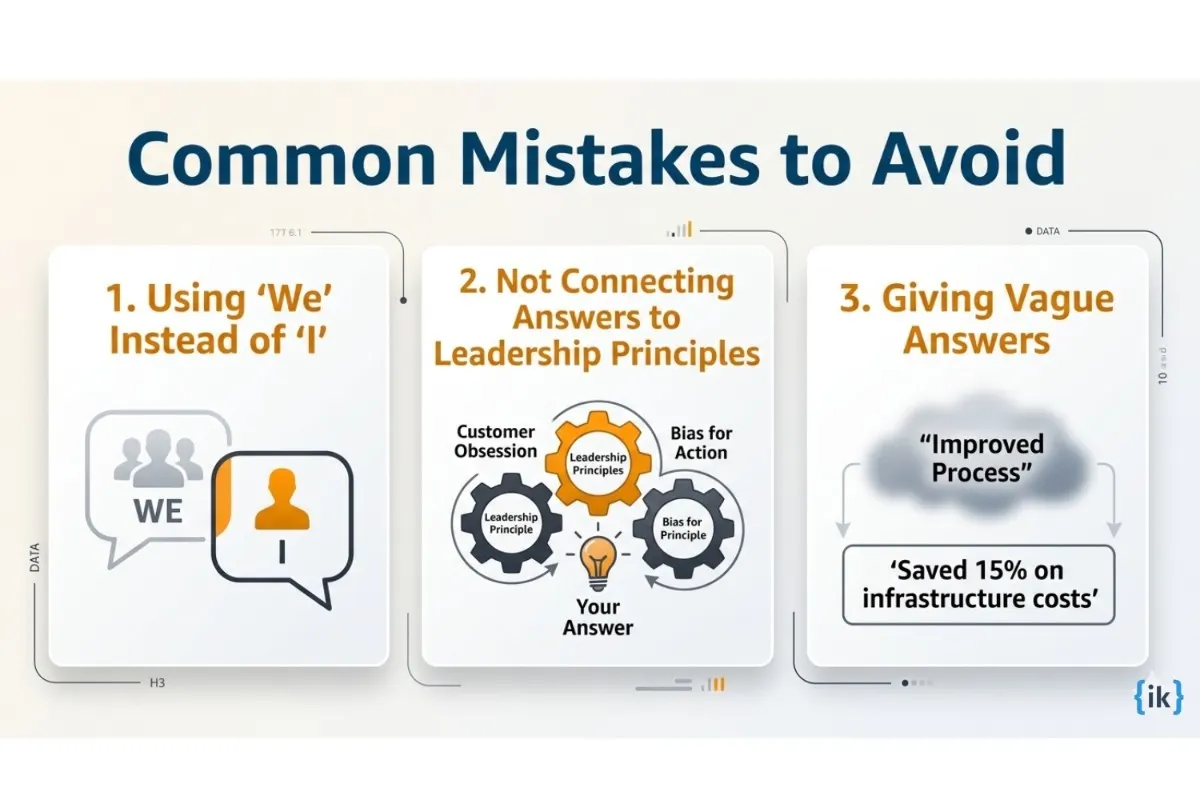
Amazon behavioral interview questions are less about sounding impressive and more about sounding clear, specific, and honest. That is also why behavioral interviewing works best when answers are specific, because SHRM describes it as a method that uses highly specific questions to assess past behavior, skills, and fit2.
A strong answer can still fall flat if it misses the point of the question.
1. Using ‘We’ Instead of ‘I’
It is fine to mention teamwork, but Amazon interviewers also want to know what you actually did. If the whole answer is built around we did this and we handled that, your own contribution gets lost.
A better approach is to explain the team context first, then be direct about your role. Say what you owned, what decisions you made, and how your actions affected the outcome. That gives the interviewer a fair picture of your work.
2. Not Connecting Answers to Leadership Principles
At Amazon, behavioral answers are not random stories. They are usually measured against one or more Leadership Principles. If your example is good but does not connect back to the principle behind the question, it can come across as incomplete.
Before you answer, take a second to think about what the interviewer is really testing.
- Is it ownership?
- Customer obsession?
- Bias for action?
Once you know that, shape your answer around it. The story should still sound natural, but it should also clearly match the principle being evaluated.
3. Giving Vague Answers
General answers do not help much in an Amazon interview. Saying that you improved a process or helped a customer is too broad unless you explain what happened, what you changed, and what the result was.
The strongest answers usually include enough detail to make the situation feel real. Give a brief setup, explain the challenge, describe what you did, and end with a concrete result. That kind of storytelling is much easier to follow, and it leaves a far better impression.
Prepare for Amazon Interviews with Interview Kickstart
Amazon’s own Leadership Principles and Interview Kickstart’s Amazon prep guides both point to the same thing. Strong preparation is not just about memorizing answers, but about practicing real stories, clear structure, and measurable results.
Interview Kickstart helps candidates get ready for FAANG interviews with live classes, including Amazon behavioral interview questions, along with mentorship from FAANG+ engineers, 1:1 support, and mock interviews that are designed to feel close to the real thing.
Our programs also include behavioral interview prep, coding, system design, and career coaching, so candidates can work through the full Amazon loop instead of preparing one piece at a time.
For Amazon-specific prep, you can also explore Amazon software engineer interview questions and the Amazon interview process to understand what shows up in each round and how the behavioral interview fits into the bigger picture.
Conclusion
Amazon behavioral interview questions are really a test of how you think, how you act, and how well your experience lines up with Amazon’s Leadership Principles. That is why strong answers do more than tell a story. They show judgment, ownership, and follow-through.
The STAR method keeps those answers focused and easy to follow. It gives you a simple way to explain the situation, your role, what you did, and what changed because of it.
Like most interview skills, this gets easier with practice. The more you rehearse your examples, the more natural they sound, and the easier it becomes to stay calm when the real interview starts.
FAQs: Amazon Behavioral Interview Questions
Q1. How many Amazon behavioral interview questions should I prepare?
Most candidates prepare 8–12 strong stories that can be adapted across different Amazon behavioral interview questions. Since questions often overlap across Leadership Principles, one well-prepared example can answer multiple behavioral interview questions Amazon tends to ask.
Q2. Are Amazon behavioral interviews harder than technical interviews?
They are different, not necessarily harder. Technical rounds test problem-solving skills, while Amazon behavioral interview questions test how you think, act, and handle real situations. Many candidates find the behavioral interviews Amazon conducts challenging because they require detailed, real examples.
Q3. Can I reuse the same example for multiple Amazon behavior questions?
Yes, but it needs to be adjusted based on the question. One experience can highlight ownership in one answer and decision-making in another. The key is to align your story with the specific Amazon behavioral interview questions and leadership principles being tested.
Q4. How far back should my examples go for Amazon behavioral questions?
Recent examples, from the last 2–4 years, are preferred, especially from professional experience. However, if you are a fresher, strong academic or project-based examples can still work for Amazon behavioral interview questions.
Q5. Do Amazon interviewers ask follow-up questions in behavioral rounds?
Yes, almost always. After your initial answer, interviewers often dig deeper to understand your thinking, decisions, and impact. This is a core part of the behavioral interview questions Amazon uses to evaluate candidates beyond surface-level responses.
References
- SHRM – Behavior-Based Hiring Effectiveness
Recommended Reads: