Agile interviewers don’t look for candidates who can recite the definition of a sprint. They are looking for evidence that you have handled retrospectives that led nowhere, negotiated scope against fixed deadlines, and protected a sprint goal when priorities kept changing. Preparing for Agile interview questions means preparing for those real situations.
This article covers 30+ questions and answers across basic, intermediate, testing, behavioural, scenario, and red-flag topics, with a quick-reference table and clear callouts on what interviewers are actually testing beneath each question.
Key Takeaways
- Agile interview questions test real delivery judgment, not just textbook definitions.
- Strong answers connect Agile values to sprint planning, estimation, testing, and team collaboration.
- Intermediate agile methodology interview questions focus on metrics, frameworks, and handling change without losing focus on delivery.
- Behavioural and scenario questions reveal how you manage stakeholders, conflict, and process breakdowns.
Basic Agile Interview Questions
These questions establish baseline fluency. Interviewers use them to confirm that a candidate has internalised Agile as a way of working, not just as a terminology set. Weak answers here signal that more complex questions will be shaky too.
Q1. What is Agile, and what problem does it solve?
Agile is an iterative approach to software delivery that replaces large, front-loaded planning cycles with short delivery loops. It prevents the Waterfall trap of building the wrong product in full before receiving user feedback.
Q2. What are the four values of the Agile Manifesto?
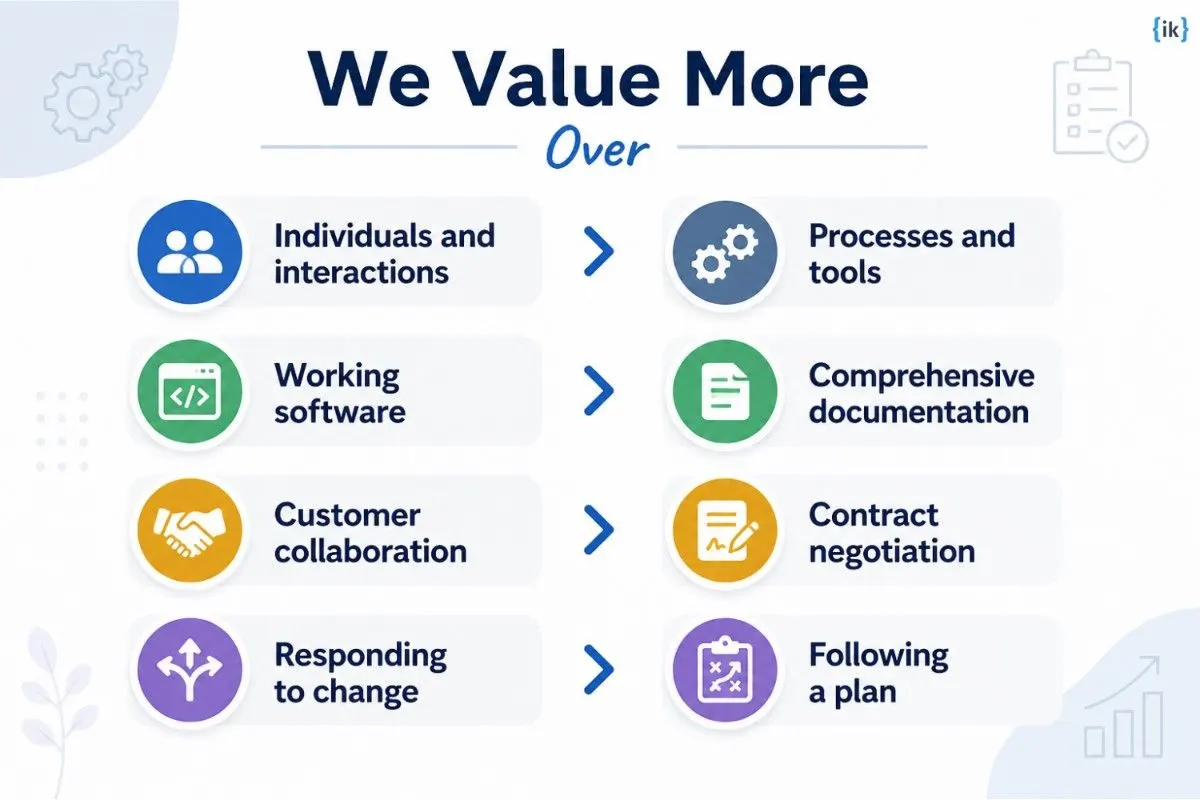
The Agile Manifesto establishes four trade-off values, not four rules. Each one says something is valued, not that the alternative is worthless.
What the interviewer is testing: Whether you understand these as trade-offs, not absolutes. The follow-up is almost always, “Give me an example of when you prioritised one over the other.” A candidate who treats “we don’t document anything” as an Agile principle has misread the manifesto entirely.
Q3. What is the difference between Agile and Scrum?
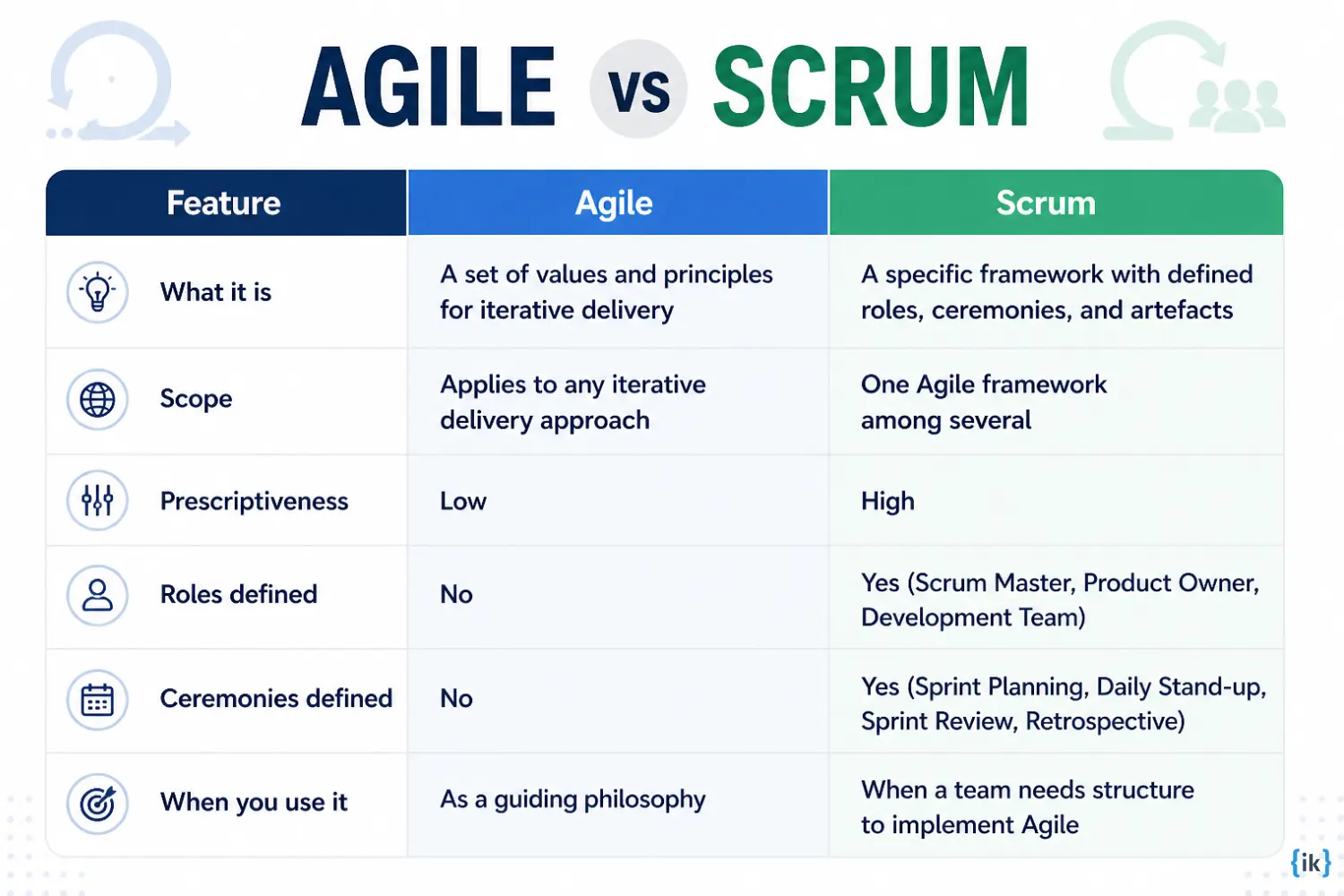
Agile is a philosophy. Scrum is one way to implement it.
What the interviewer is testing: Whether you understand that Agile is not synonymous with Scrum. Candidates who conflate the two have usually not worked in environments that use Kanban, XP, or SAFe, and the interviewer can tell.
Q4. What is the difference between Agile and Waterfall?
The following table compares Agile and Waterfall.
| Feature |
Agile |
Waterfall |
| Planning style |
Iterative; plans evolve based on feedback |
Sequential; requirements are locked upfront |
| Delivery frequency |
Working software delivered every sprint |
Full product delivered at end of project |
| Change handling |
Change is expected and accommodated |
Change is costly and discouraged after sign-off |
| Customer involvement |
Continuous feedback throughout |
Primarily at the beginning and end |
| Risk profile |
Lower; problems surface early |
Higher; problems surface late when they’re expensive |
| Documentation |
Enough to support delivery; not the measure of progress |
Comprehensive upfront documentation is standard |
| When to use it |
Uncertain requirements; evolving products |
Fixed scope; regulated or hardware-dependent projects |
Q5. What are the 12 Agile principles, and which ones come up most in interviews?
The 12 principles from the Agile Manifesto are:
- Deliver valuable software continuously and early
- Welcome changing requirements, even late in development
- Deliver working software frequently (weeks, not months)
- Businesses and developers must work together daily
- Build projects around motivated individuals and trust them
- Face-to-face conversation is the most efficient communication method
- Working software is the primary measure of progress
- Agile processes promote a sustainable development pace
- Continuous attention to technical excellence enhances agility
- Simplicity, which means maximizing the amount of work not done, is essential
- Self-organising teams produce the best architectures and designs
- Teams reflect regularly and adjust their behaviour accordingly
Interviewers probe four of these most often:
- continuous delivery (principles 1 and 3),
- welcoming change (principle 2),
- sustainable pace (principle 8), and
- self-organising teams (principle 11).
Expect follow-up questions asking how you have applied each one under real constraints.
Q6. What is a user story, and what makes a good one?
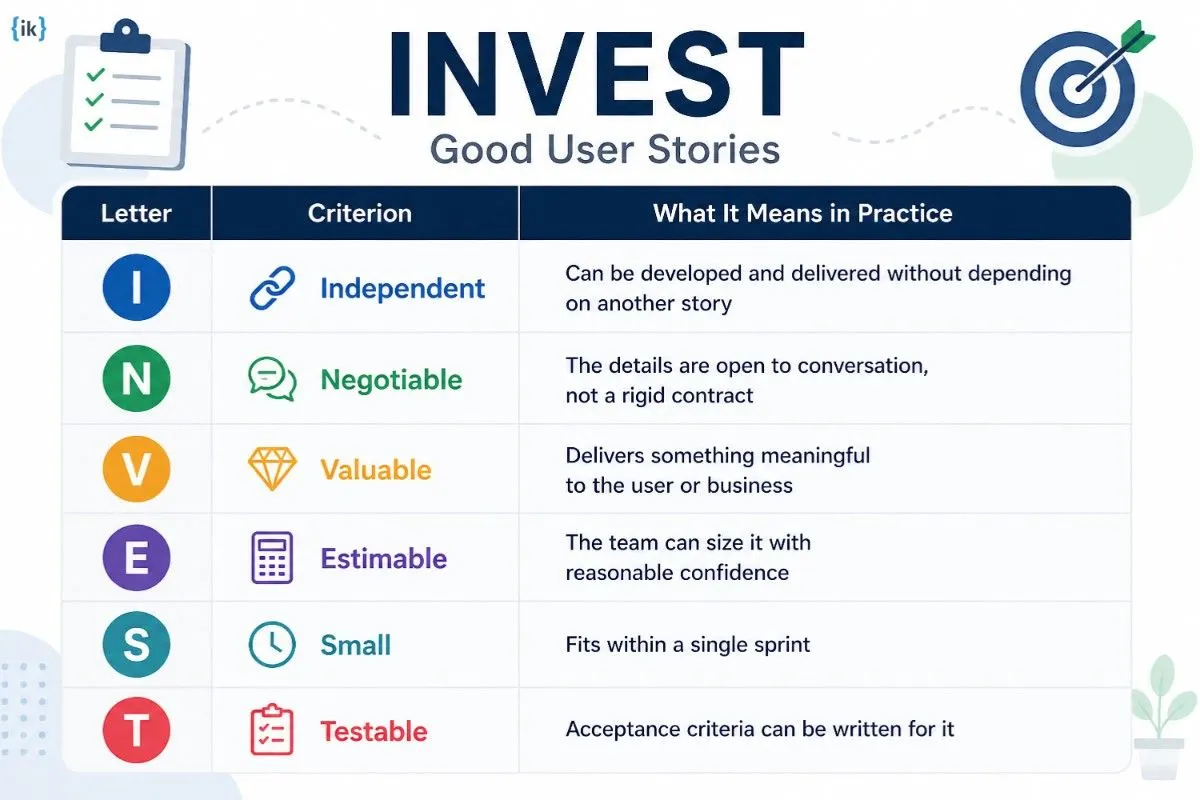
A user story is a short, outcome-focused description of a feature written from the user’s perspective. The standard format is: “As a [role], I want [goal], so that [benefit].” Quality is assessed against the INVEST criteria: Independent, Negotiable, Valuable, Estimable, Small, and Testable. A story that cannot be independently deployed or estimated is usually too large or too vague.
Q7. What is a sprint, and what happens during one?
A sprint is a fixed-length development cycle, typically one to four weeks, during which a team builds a working, potentially shippable product increment. In many scrum master interview questions, candidates are expected to explain how each sprint includes four key ceremonies: Sprint Planning, Daily Stand-up, Sprint Review, and Sprint Retrospective.
Q8. What is the difference between a product backlog and a sprint backlog?
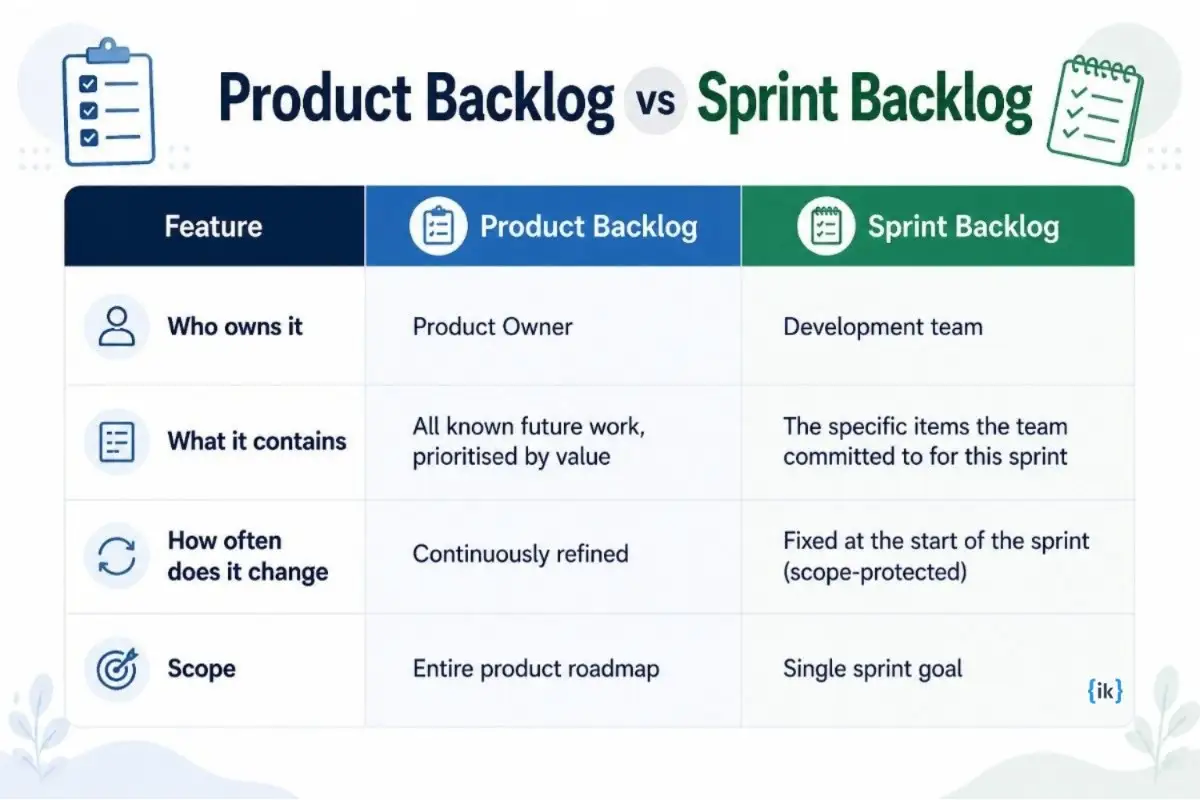
The product backlog is the full, ordered list of everything that could be built, owned and prioritised by the Product Owner. The sprint backlog is the subset of items the team commits to completing in the current sprint, selected during sprint planning. The product backlog is always changing; the sprint backlog is stable for the duration of the sprint.
Q9. What is velocity in Agile, and how is it used?
Velocity is the average number of story points a team completes per sprint, measured over several sprints. It is used for forecasting. Given a backlog of known size, a team can estimate how many sprints it will take to complete it. Velocity is a team-level metric. Comparing velocity across teams is a well-known Agile anti-pattern because teams calibrate their own story point scales independently.
Q10. What is the Definition of Done?
The Definition of Done (DoD) is a shared, explicit agreement on what must be true before a story is considered complete, including coded, reviewed, tested, documented, and deployable work. It differs from acceptance criteria in scope. Acceptance criteria are story-specific conditions that must be met. The DoD applies to every story, every sprint.
Intermediate Agile Interview Questions
These questions test judgment, not just knowledge. Interviewers want to know whether a candidate can choose the right framework, interpret metrics correctly, and handle practical Agile challenges.
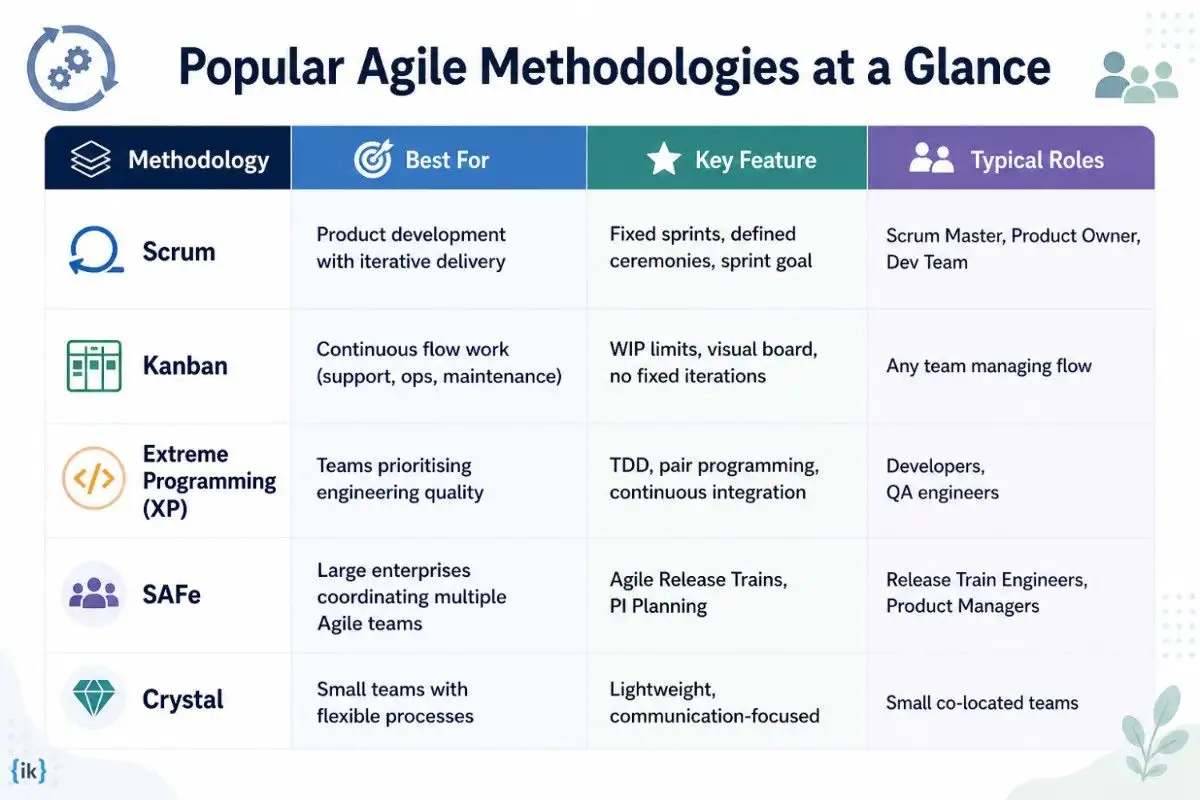
Q11. What are the main Agile methodologies, and when would you use each?
The image shows the main Agile methodologies.
Q12. What is story point estimation, and why do teams use it instead of hours?
Story points estimate effort in relative terms, not time. A team assigns points based on complexity, uncertainty, and effort compared to a reference story, not based on the hours a task will take.
This approach works better than hour-based estimation because it accounts for the fact that individuals work at different speeds, complexity is easier to compare than duration, and estimates are shared rather than individual.
What the interviewer is testing: Whether you understand that estimation is about building a shared mental model of the work, not predicting time accurately. A candidate who says “we use a 1 point equals 1 hour rule” has missed the point of relative sizing entirely.
Q13. What is backlog refinement, and who should be involved?
Backlog refinement is the ongoing process of reviewing, clarifying, and sizing upcoming backlog items before they enter sprint planning. It involves the Product Owner, Scrum Master, and the full development team.
Treating refinement as a Product Owner-only activity produces poorly understood stories and planning sessions that break down. The development team needs to be in the room because they are the ones sizing the work.
Q14. What is the difference between a burndown chart and a burnup chart?
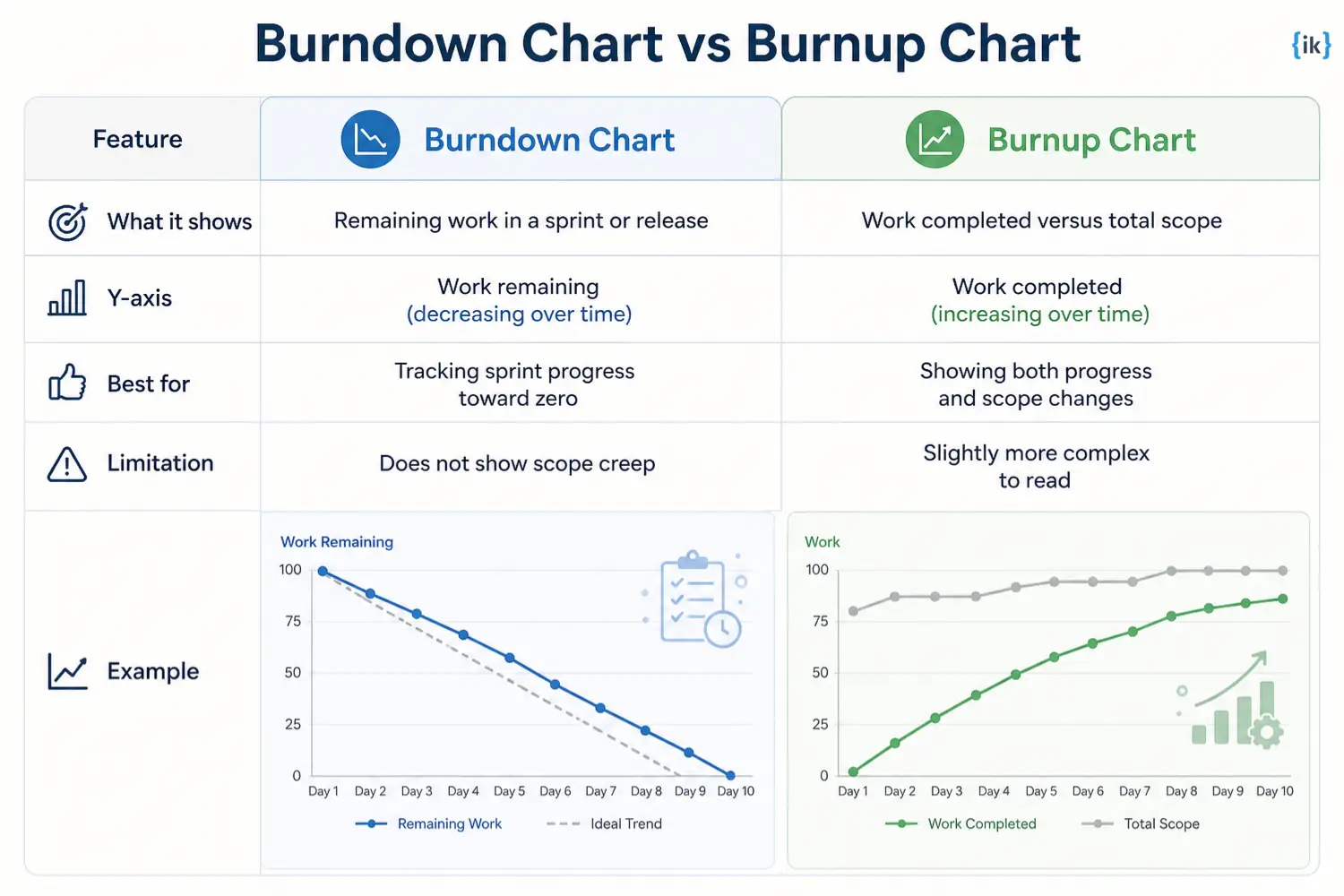
A burndown chart shows how much work remains in the sprint or release over time. The ideal line slopes downward to zero by the end. A burnup chart shows both how much work has been completed and the total scope of work. This makes burnup charts more useful when scope changes during the sprint or release, because the total line moves when stories are added or removed, making the impact of the scope change visible.
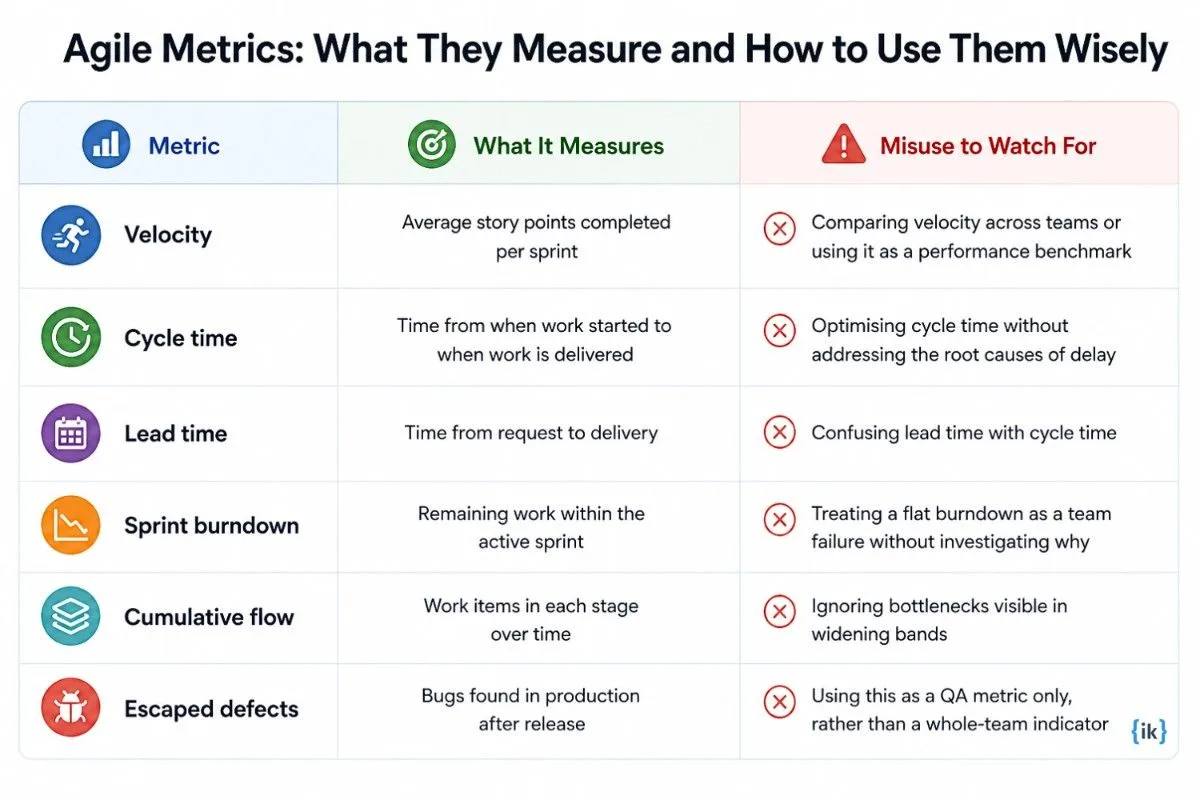
Q15. What are the key Agile metrics and what do each measure?
The following image presents key Agile metrics.
Q16. What is the difference between iterative and incremental development?
Iterative development means building something, getting feedback, and improving it in repeated cycles. Incremental development means building the product in parts, with each part adding to what has already been delivered.
Agile is both. Each sprint produces a working increment, and the product evolves based on feedback from previous sprints. Confusing the two suggests the candidate has not thought carefully about how delivery actually works in Agile.
Q17. How do you handle changing requirements mid-sprint?
The standard Agile position is that the sprint scope is protected once planning is complete. The sprint goal exists to give the team a clear, focused objective, and mid-sprint additions undermine that focus.
In practice, the Product Owner holds new requests in the backlog for the next sprint. Where a change is genuinely urgent, the team and PO can agree to swap a story of equal size out of the sprint, or in rare cases, cancel the sprint and replan.
What the interviewer is testing: Whether you know the difference between protecting team focus and being inflexible. Strong candidates acknowledge that change is expected in Agile. The question is where and when it enters the system.
Q18. What is a retrospective, and what makes one effective?
A retrospective is the final sprint ceremony focused on improving how the team works, not reviewing what was built. Teams typically discuss what went well, what needs improvement, and what action to take next.
An effective retrospective leads to clear action items with named owners, reviews progress from the previous sprint, and creates enough psychological safety for people to raise genuine issues instead of surface-level feedback.
Q19. What is SAFe, and when does it apply?
SAFe is a framework for coordinating Agile delivery across multiple teams working on the same product or programme. Its central concept is the Agile Release Train (ART), a group of 50 to 125 people aligned to a shared mission, delivering value in Program Increments (PI) of 8 to 12 weeks.
SAFe applies when an organisation has more work than a single Agile team can handle and needs synchronised planning across teams. It is overkill for teams of fewer than 30 to 40 people, and introducing it in that context typically adds process overhead without proportional benefit.
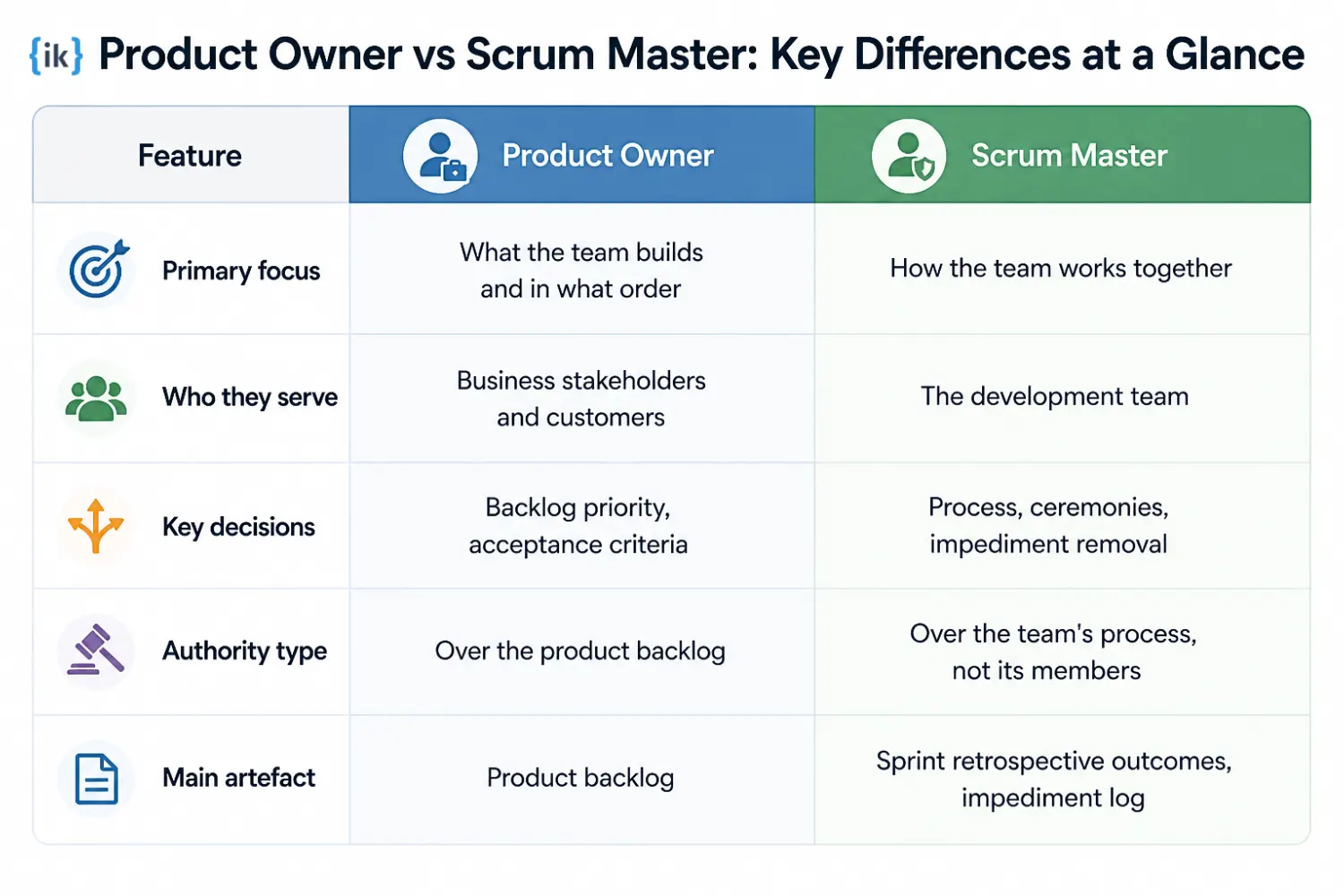
Q20. What is the difference between a Product Owner and a Scrum Master?
The following image compares Product Owner and Scrum Master roles.
Agile Testing Interview Questions
QA engineers and developers in Agile teams are asked about testing in a dedicated round or as part of general Agile questions. These questions assess whether a candidate understands that testing in Agile is not a phase at the end of the sprint. It is continuous, collaborative, and built into how the team defines and accepts work.
Q21. What is Agile testing, and how does it differ from traditional testing?
In traditional testing, QA is a gate at the end of development. In Agile, testing runs throughout the sprint alongside development. Testers collaborate with developers and the Product Owner from the moment a story is picked up, contributing to acceptance criteria and catching defects before they compound.
Q22. What is Test-Driven Development (TDD)?
TDD is a development practice where a failing test is written before any production code. The cycle is red (write a failing test), green (write the minimum code to pass the test), and refactor (clean up the code without breaking the test). TDD shifts quality left. It forces clarity about what code should do before it is written, and it creates a regression safety net as the codebase grows.
Q23. What is Behaviour-Driven Development (BDD) and how does it differ from TDD?
BDD extends TDD by focusing on the behaviour of the system from the user’s perspective, written in plain language that both technical and non-technical stakeholders can read. Where TDD tests are written by developers for developers, BDD scenarios are written collaboratively by product owners, business analysts, and testers using a Given-When-Then format.
The difference is in audience and scope. TDD ensures code correctness, and BDD ensures the right behaviour is being built.
Q24. What is Acceptance Test-Driven Development (ATDD)?
ATDD is a practice where the team agrees on acceptance tests for a story before any code is written. Unlike BDD, which emphasises behaviour specification in plain language, ATDD focuses on the contractual agreement between the team and the Product Owner. These are the conditions that must be met for the story to be accepted.
Q25. What is continuous integration, and why does it matter for Agile testing?
Continuous integration (CI) means developers merge code to a shared branch frequently, and each merge triggers an automated build and test run. In Agile, where sprints are one to four weeks long, CI is what makes short delivery cycles sustainable.
Without it, integration happens late, and defects pile up. A passing CI pipeline is often part of a team’s Definition of Done, ensuring that code is tested and integrated before a story is considered complete.
Q26. What should an Agile tester do if a bug is found during a sprint?
A bug found during the sprint should be raised immediately with the developer responsible and, if it affects the sprint goal, flagged to the Scrum Master and Product Owner. Small bugs can be fixed within the sprint without creating a formal story.
Larger bugs that require significant effort should be added to the backlog as a story and prioritised by the PO. Allowing bugs to accumulate silently until the end of the sprint is one of the patterns that creates sprint review surprises and erodes trust between QA and development.
Agile Behavioural Interview Questions
Behavioural questions are where most candidates underperform, not because they lack experience, but because they answer in generalities. Interviewers at senior levels are pattern-matching for specific behaviours.
Each question below includes the competency being assessed and what distinguishes a strong answer from a weak one.
Q27. Tell me about a time you worked on a team that struggled with Agile adoption. What did you do?
Competency tested: Change management and Agile mindset
A strong answer identifies a specific resistance point, such as a developer refusing to break work into stories or a manager bypassing sprint planning. It should clearly explain what the candidate did, and describe the outcome. The answer should show action and ownership rather than waiting for someone else to fix the issue.
Weak answer pattern: “We held workshops and explained the benefits of Agile.” This describes an event, not a person’s contribution, and shows no judgment about what actually caused the resistance.
Q28. Describe a sprint where the team could not complete everything in the backlog. How was it handled?
Competency tested: Realistic planning and transparency
A strong answer covers how the shortfall was identified early and how the Product Owner was informed proactively, what was cut versus carried forward, and what the retrospective surfaced about the root cause.
Weak answer pattern: “We worked overtime to finish everything.” This signals a candidate who conflates commitment with overextension and who does not understand that sustainable pace is an Agile principle.
Q29. Give an example of a time a stakeholder wanted to change requirements mid-sprint. How did you handle it?
Competency tested: Stakeholder management and scope protection
A strong answer acknowledges the business reason behind the request, explains how the sprint protection principle was communicated without being dismissive, and describes how the change was logged and prioritised for the next sprint.
Weak answer pattern: “We just added it to the sprint.” This shows no understanding of sprint integrity and signals a team that operates in chaos rather than Agile.
Q30. Tell me about a time a retrospective led to a real change in how your team worked.
Competency tested: Continuous improvement
A strong answer names a specific problem that was raised, the action the team agreed to, how it was implemented, and what measurably improved. Specificity is everything here.
Weak answer pattern: “We always had retrospectives, and they were very useful.” This says nothing. It is the answer of someone who attended retrospectives but did not engage with them.
Q31. How have you handled a situation where two team members disagreed on the approach to a problem during a sprint?
Competency tested: Team collaboration and conflict resolution
A strong answer describes the specific disagreement, what the candidate did to help the team move forward, and the outcome. The interviewer wants to see that the candidate can navigate disagreement without either escalating unnecessarily or letting it drag on.
Weak answer pattern: “I told them to focus on the team goal.” This is a non-answer. It tells the interviewer nothing about how the situation was actually handled.
Q32. Describe a time you gave feedback that improved your team’s Agile process.
Competency tested: Proactive ownership and communication
A strong answer names a specific observation, how the candidate raised it, what changed, and what the impact was. The detail is what signals genuine ownership.
Weak answer pattern: “I always gave feedback in retrospectives.” Always and never are red flags in behavioural interviews. They replace a specific example with a claim.
Q33. Tell me about a time you had to push back on a Product Owner’s prioritisation decision.
Competency tested: Constructive challenge and technical judgment
A strong answer explains the specific concern, how the candidate framed it in terms of delivery risk rather than personal preference, and what happened. Interviewers are looking for candidates who understand that pushback is part of healthy team dynamics, not insubordination.
Weak answer pattern: “I just did what the Product Owner said.” This signals a candidate who treats the PO as a manager rather than understanding the collaborative nature of Agile roles.
Q34. Give an example of when your team used Agile metrics to change how they worked.
Competency tested: Data-driven decision making
A strong answer names a specific metric, the team’s diagnosis of the cause, the change made, and the outcome. The data is the starting point, not the conclusion.
Weak answer pattern: “We reviewed our velocity at retrospectives.” Reviewing and acting are different things. An interviewer wants to know what the data caused the team to do differently.
Agile Scenario Questions
Scenario questions test whether a candidate can navigate real Agile problems, not just describe what should theoretically happen. The situations below are common in actual Agile teams.
Scenario 1: Your Product Owner keeps adding new stories to the sprint backlog after sprint planning. What do you do?
First, address it directly with the Product Owner in a private conversation rather than raising it publicly in a ceremony. Explain the impact on the sprint goal and the team’s ability to deliver what was committed. The standard channel for new requests is the product backlog, where items are prioritised and picked up in the next sprint.
If the pattern continues despite the conversation, bring it to the retrospective as a process issue, not a people issue. The exception is a genuinely urgent and critical business request. In that case, the PO and team can agree to swap an equivalent-sized story out of the sprint. The key distinction is between a legitimate priority shift and habitual scope creep.
Scenario 2: Your team has been running retrospectives for six months, but nothing ever changes. What is the problem, and what do you do?
There are three common root causes. The first is a psychological safety problem where people are not raising real issues because they fear judgment or consequences. The fix is to change the format using anonymous input tools or smaller group conversations, and have the Scrum Master directly address the safety issue.
The second is format fatigue, where the team has used the same retrospective structure for too long, and engagement drops. Introduce a different retrospective format. The third is an accountability gap where actions are agreed upon but never reviewed. Start each retrospective by reviewing the previous sprint’s action items and assigning every new action a clear owner and deadline.
Scenario 3: Sprint velocity drops significantly over three consecutive sprints. How do you investigate?
Start by ruling out external factors, including team composition changes, holidays, and unplanned work that was absorbed silently. If those do not explain the drop, look at story-level patterns:
- Are certain types of stories consistently carrying over?
- Is the team pulling too many stories into sprint planning?
Then look at process patterns such as:
- Are stand-ups surfacing blockers that are not being resolved?
- Is technical debt accumulating in ways that slow development?
Bring the data to the retrospective without framing it as a performance problem. Ask the team, “What is getting in your way that we have not addressed?”
Scenario 4: A stakeholder demands a fixed delivery date for a feature set that is still being refined. How do you respond?
Acknowledge the deadline, then explain what can realistically be forecast based on current velocity and backlog size. Give a delivery range, not a single commitment, and define the minimum viable scope that can be delivered by that date.
Propose an MVP milestone that delivers the core value by the required date, with the remaining scope in the following sprint. Flag the risk explicitly: by fixing both scope and date, something will give — either quality, scope, or the date itself. The stakeholder should make that trade-off knowingly, not discover it at the end.
Scenario 5: A team member from a Waterfall background is frustrated with not having a detailed upfront plan. How do you help?
Start by acknowledging that the discomfort is real and that the adjustment takes time. Then map Waterfall concepts to their Agile equivalents. For instance, the product roadmap is the high-level plan, the sprint backlog is the two-week detailed plan, and the Definition of Done replaces the formal sign-off checkpoint.
Give them a concrete early win by involving them in backlog refinement, where they can ask the clarifying questions they are used to asking during requirements gathering. Check in regularly rather than assuming adaptation is happening on its own.
Red Flags and Common Mistakes in Agile Interviews
Interviewers who have managed Agile teams recognise these patterns immediately. Each one signals that a candidate has read about Agile rather than worked in it.
1. “In Agile, we don’t document anything.”
This misreads the manifesto. The value is working software over comprehensive documentation, not instead of it. Strong candidates know that documentation is still valued and produced in Agile. It is not treated as the primary proof of progress.
2. “The Product Owner decides what goes into the sprint.”
The Product Owner prioritises the product backlog. The development team selects the sprint backlog during sprint planning. Confusing these two is a signal that the candidate has not been in actual sprint planning sessions.
3. “Velocity is how we measure team productivity.”
Velocity is a forecasting tool. Using it to compare teams or evaluate individual productivity is a well-documented Agile anti-pattern. Strong candidates name this explicitly and describe what they use instead for productivity conversations.
4. “We don’t need retrospectives once the team is mature.”
Continuous improvement is not a phase that ends when the team gets good. It is a permanent practice. A team that has stopped holding retrospectives has usually stopped improving, even if no one has noticed yet.
5. “We do Agile, but we have a fixed scope and a fixed deadline.”
Strong candidates do not pretend that this contradiction does not exist. They name it as a constraint, describe how the team managed the tension, and explain what trade-offs were made.
6. “The Scrum Master is the team lead.”
The Scrum Master has no line authority over team members. This is a foundational distinction. Candidates who describe the Scrum Master as a manager have likely worked in teams where the role was implemented incorrectly, and they do not yet know it.
Agile Interview Quick Reference
The following image provides a checklist of key concepts that you should remember while preparing for Agile interview questions:
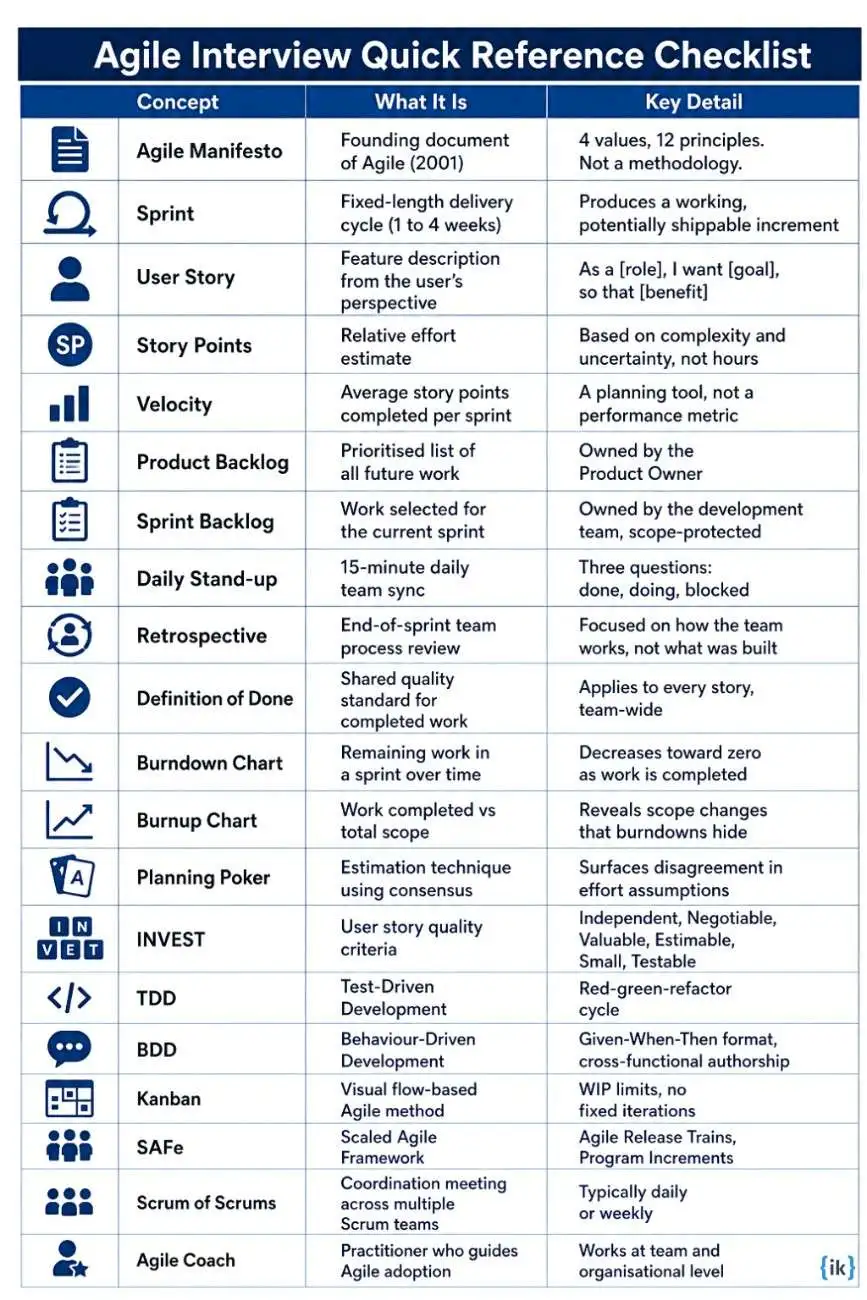
Prepare for Agile Interviews with Interview Kickstart
Strong Agile interviews test how you handle planning tradeoffs, delivery pressure, and changing priorities in real team environments.
Interview Kickstart’s Technical Program Manager Interview Prep program is the best fit here for Agile, Scrum, and project management interview prep.
- FAANG+ led coaching on delivery and execution
- Mock interviews and structured feedback
- 1-on-1 support, resume, and behavioral prep
Start your Agile interview prep today.
Conclusion
At senior levels, Agile interviewers want to hear how you handle the messy parts of delivery, not how well you can repeat Agile terms. They listen for judgment in planning, estimation, stakeholder conversations, testing decisions, and team execution. Use the quick reference to tighten the basics, then spend most of your time on the scenario and behavioural sections, because that is where practical experience shows.
FAQs: Agile Interview Questions and Answers
Q1. How do I handle a Scrum-fall environment where leadership demands Agile but uses Waterfall deadlines?
Be honest but professional. Explain how you used Agile ceremonies to manage risk and provide transparency within those constraints. Highlight your ability to protect the team’s focus while meeting external reporting requirements.
Q2. Is it a red flag if an interviewer asks how I track individual developer productivity?
Yes. Agile measures team outcomes and working software, not individual keystrokes. A strong answer shifts the focus to team velocity and meeting the Sprint Goal, as individual tracking often destroys psychological safety.
Q3. How do I explain Story Points to a stakeholder who only wants to talk about hours?
Use the relative sizing analogy. It is easier to agree that a project is a mountain or a molehill than to predict the exact minute you will reach the top. Points account for complexity and uncertainty, which hours ignore.
Q4. What is the Agile Failure question really testing?
Interviewers are looking for a recovery arc. Discuss a specific failed sprint or missed goal. Focus on how the Retrospective led to a concrete process change that prevented the error from happening again.
Q5. How do I answer questions about Jira when my previous team used a different tool?
Focus on the methodology, not the buttons. Explain how you used boards for workflow visibility, WIP limits, and tracking blockers. Tools are secondary to the Agile principles they support.
References
- What is Agile?
- Agile 101
Related Articles: